
 Facebook
 X
X
 Pinterest
 Copy Link

Texas Water Rights: What Buyers and Sellers Need to Know Before Closing
Water can be one of the most appealing features of a Texas property. A private well, pond, creek or stock tank may be exactly what attracts a buyer to a piece of land.
But when it comes to a real estate transaction, water can also raise important questions about ownership, use, regulation and disclosure.
Those questions have become even more important with changes to Texas real estate contracts that took effect July 1, 2026, including a new Seller’s Disclosure About Groundwater and Surface Water Rights.
If you own, are selling, or are considering buying Texas acreage, here are a few things worth knowing.
A New Water Rights Disclosure in Texas
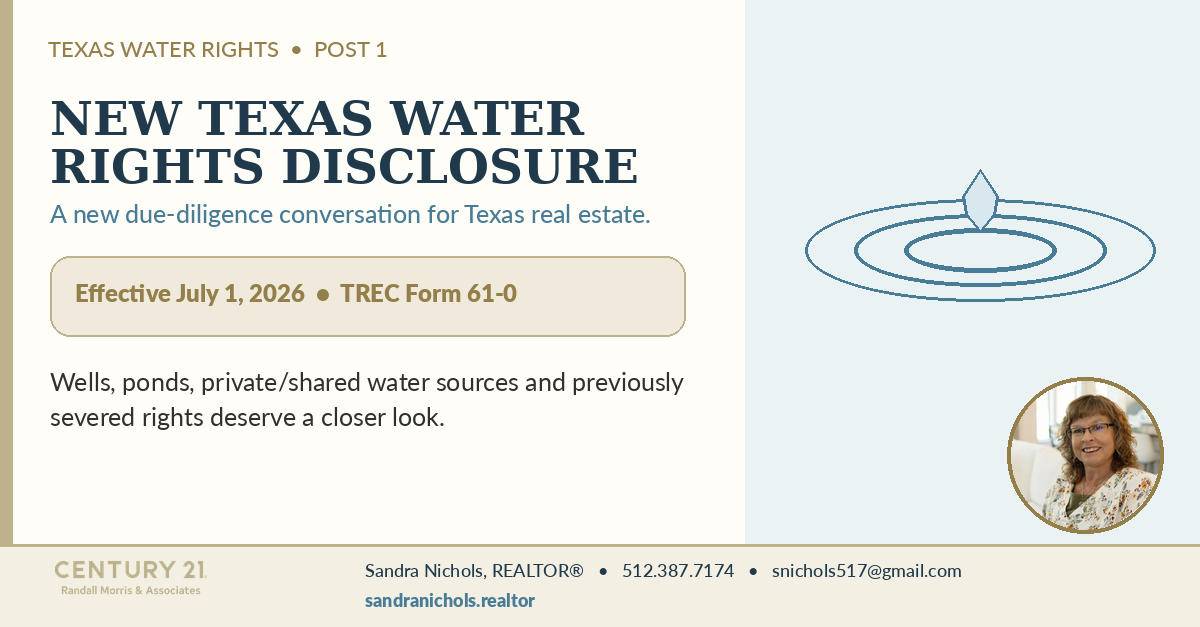
The new TREC water-rights disclosure is designed to bring attention to certain water-related conditions associated with a property.
Some of the things that should prompt additional questions include:
- A water well — including a well that is no longer being used, capped or abandoned
- A pond, lake or water tank
- Known surface-water rights
- Groundwater rights that may have previously been sold, leased or severed
- Water supplied from a private or shared source
One important distinction is that simply being located within a Groundwater Conservation District does not, by itself, trigger the disclosure.
The individual characteristics of the property matter.
For buyers and sellers, the important takeaway is not that every well or pond creates a problem. It simply means water-related issues should be identified early enough for the parties to ask questions and investigate when appropriate.
Groundwater and Surface Water Are Not the Same
One of the more confusing things about Texas water law is that not all water is treated the same way.
Groundwater
Groundwater is generally considered a private property right associated with the land unless those rights have previously been separated or severed from the property.
However, owning groundwater rights does not necessarily mean there are no regulations affecting how that groundwater can be used.
Depending on the property’s location, a Groundwater Conservation District or another water authority may have rules concerning wells, including permitting, registration, well spacing or groundwater production.
Surface Water
Water in rivers, natural streams and other watercourses is generally considered state water and is regulated differently.
Some uses may be exempt from permitting requirements, while other uses may require authorization through the Texas Commission on Environmental Quality.
Rainfall and Runoff
There is another category known as diffused surface water.
This generally includes rainfall, drainage water and runoff before it reaches a natural watercourse. That water may be treated differently and can, under certain circumstances, be captured by the landowner before it enters a watercourse.
So even on a single property, there may be several very different types of water — with very different rules.
Buying Texas Acreage? Follow the Water
When buyers are looking at acreage, they naturally tend to focus on things like:
- Property boundaries
- Restrictions
- Taxes
- Septic
- Utilities
- Access
- Agricultural exemptions
I would add water to that list.
If there is a well on the property, ask whether it is active and being used.
If it is not being used, find out whether it has been capped, plugged or abandoned.
Other questions may include:
- Is the well shared with another property?
- Where does the property’s water actually come from?
- Is the property located within a Groundwater Conservation District or another water authority?
- Are there ponds, stock tanks, creeks or other watercourses?
- Have any groundwater rights previously been sold, leased or reserved?
- If you want to drill an additional well in the future, what rules might apply?
The answers can be particularly important if your plans involve livestock, irrigation, gardening, agricultural use, additional development or simply maintaining a reliable private water supply.
Don’t Forget the Old Well
One detail that can easily be overlooked during a sale is an old well that hasn’t been used in years.
A seller may understandably think, “We don’t use it anymore, so it really doesn’t matter.”
But the new disclosure specifically addresses known wells that are in use or not in use, including wells that have been capped or abandoned.
That doesn’t automatically mean there is anything wrong with the property.
It simply means the well should be identified rather than ignored.
Finding out about it before the property is under contract gives everyone more time to determine whether additional information or investigation is necessary.
Water Rights Can Be Separated From the Property
Buyers should also avoid assuming that every groundwater right automatically transfers simply because they are purchasing the land.
Groundwater rights are generally associated with the property unless they have been legally separated.
In some real estate transactions, however, owners have reserved, sold or leased some or all of those rights.
That can make a review of the property’s history and deed records particularly important when water is a significant part of the property’s value or intended use.
The Smooth Closings Takeaway
Water issues do not have to make a Texas real estate transaction difficult.
What tends to create problems is discovering an important issue late in the transaction.
For sellers, identifying wells, ponds, private water arrangements and known water-rights issues before listing can help avoid surprises.
For buyers, asking how a property receives its water — and understanding what water rights actually come with the property — should be part of the due-diligence process, particularly when purchasing acreage.
A pond may be beautiful.
A private well may be a tremendous asset.
And a creek running through a property can be one of its best features.
The important thing is to understand what you are buying.
Ask questions early. Follow the water. And investigate before you assume.
Thinking about buying or selling acreage or a property with a private well, pond or other water feature? I’m happy to help you identify the real estate questions that should be addressed as part of the transaction.
Sandra Nichols, REALTOR®
CENTURY 21 Randall Morris & Associates
512.387.7174
snichols517@gmail.com
sandranichols.realtor
This article is provided for general real estate education and is not legal advice. Questions concerning the ownership, conveyance, reservation or interpretation of water rights should be directed to an attorney.


